
Does Perimenopause Cause Back Pain? Why Your Back May Suddenly Hurt in Midlife And What You Can Do About It

You bend down to put on your shoes and your lower back catches. You wake up stiff even though you did nothing particularly strenuous the day before. That familiar ache beside your spine suddenly seems to live there permanently.
Or perhaps you have the more frustrating version:
You go to the physio. You stretch. You strengthen. You massage it.
It improves.
And then, a few days later
there it is again.
If you are in your 40s or 50s, it is completely reasonable to wonder:
Does perimenopause cause back pain?
The short answer is:
Yes, but indirectly…
Perimenopause is not a diagnosis of back pain, and having back pain in midlife does not automatically mean your hormones caused it.
But the hormonal transition can change the environment your muscles, joints, connective tissues, nervous system, sleep and recovery are operating inside.
And that can expose weaknesses, movement patterns, old injuries, stress patterns and loads your body may have compensated for quite happily before.
Think of it this way:
Perimenopause may not light the fire — but it can change the weather conditions around it.
Suddenly something that your body had managed for years becomes much harder to ignore.
🌿 So Why Can Back Pain Show Up During Perimenopause?
Your back does not exist in isolation.
It is affected by how you move, how strong you are, how much you sit, how well you sleep, how quickly you recover, old injuries, pelvic stability, workload and stress.
During perimenopause, fluctuating hormones can coincide with changes in sleep, recovery, body composition, pain experience and musculoskeletal comfort.
So the workout you recovered from easily at 35 may not feel the same at 47.
The long day at the desk that never bothered you may suddenly leave you stiff.
The weakness you compensated for may finally become noticeable.
The years of carrying children on one hip, hauling bags, sitting badly, training hard, sleeping badly and simply getting on with it may start showing up differently.
This is why I prefer saying:
Perimenopause does not necessarily cause the back pain. It can change your body's tolerance for continuing exactly as it always has.
And that distinction matters.
Because if we blame everything on hormones, we can miss what actually needs attention.
🎒 Your Back May Have Been Carrying More Than You Realized

Imagine carrying a backpack.
For years you keep adding things to it: work, children, laptop, groceries, training, poor sleep, an old injury, weak glutes, hours of sitting, stress, caregiving, a relationship that drains you, a job you secretly hate, the belief that you have to handle everything yourself.
Your body keeps adapting.
Until one day someone adds one more tiny stone.
And suddenly:
“Why does my back hurt NOW?”
It may not be because of that final stone.
It may be because the system had been compensating for the whole backpack.
That is how I often think about persistent pain in midlife.
🔍 First: What Kind of Back Pain Do You Actually Have?
Before turning your pain into a metaphor, understand what you are physically dealing with, i.e. what is the likely cause for your pain.
Not all back pain is the same.
A dull, stiff ache after sitting is not the same as sharp one-sided SI pain.
And neither is the same as burning or electric pain travelling into the leg.
You might be dealing with:
muscular overload or weakness
stiffness and under-movement
SI-joint or pelvic issues
irritation around a nerve
disc-related sciatica
a movement or loading problem
persistent nonspecific low-back pain (likely due to stagnation)
That is why I would start with a good physiotherapist or appropriately qualified musculoskeletal practitioner who can help identify what movements aggravate or ease the pain, assess strength and function, and determine whether you need further medical evaluation.
But, if you’re like me and love nerding out on your physique while figuring things out for yourself - I’ve put together a guide to the Different Types of Back Pain in Perimenopause showing different patterns I experienced myself and observed in my clients in perimenopause.
🌿Don’t Stretch It -Acupuncture It!
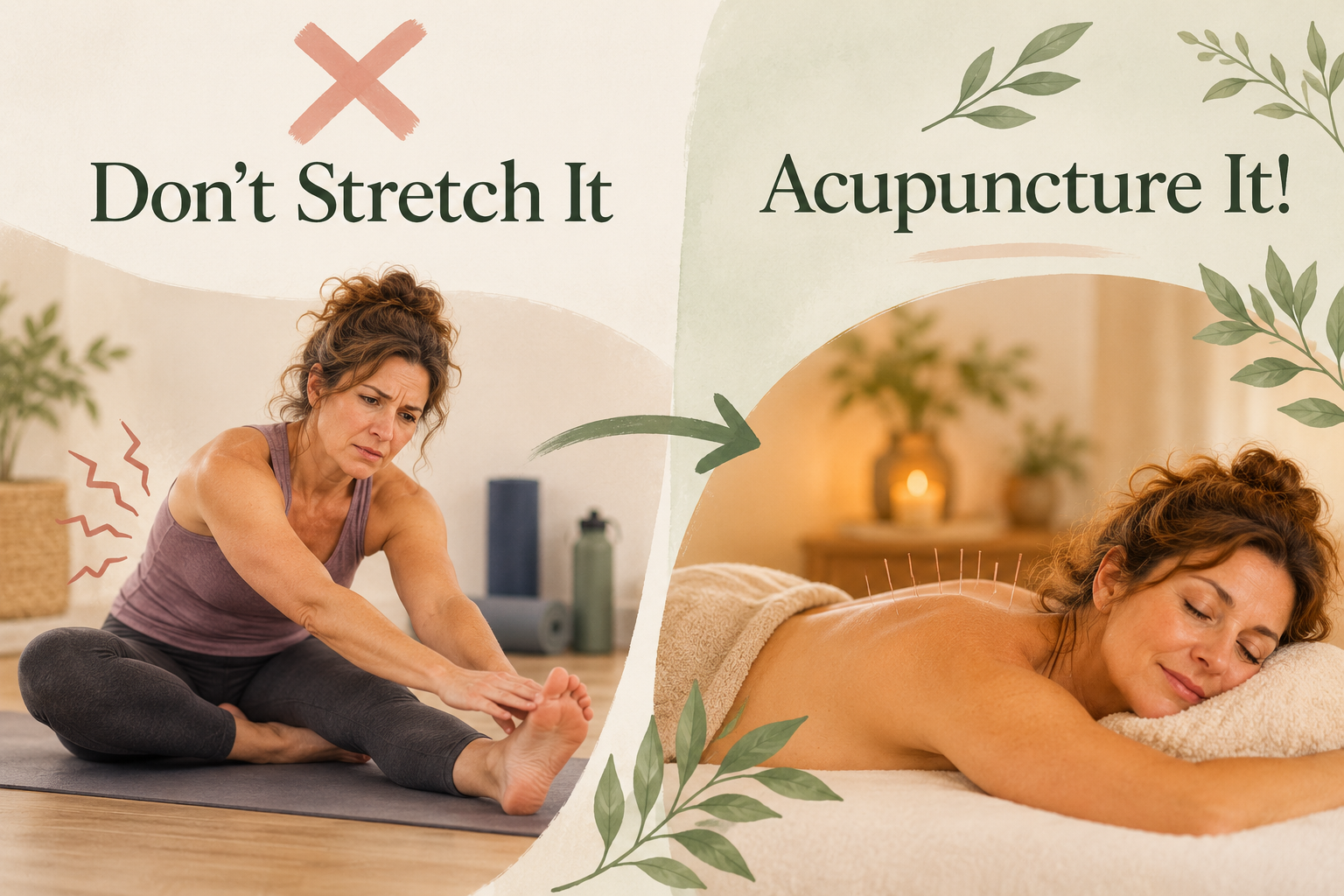
This is one of the places where my approach may
differ from the usual “stretch it and strengthen it”
advice.
When somebody has been in pain for
weeks or months and the whole area feels guarded,
tight, irritated or exhausted, I absolutely LOVE
Chinese A
cupuncture as a 1st step.
Why?
Because acupuncture is an amazing supportive tool, and it does pure magic to the body. I’ll explain.
From a Traditional Chinese Medicine perspective, acupuncture is used to work with the body’s meridian system and support the smoother movement of Qi and Blood through areas that may be described as stagnant, depleted or out of balance. In simple words it stimulates your body’s natural ability to rebalance itself.
⚠️ BEWARE of The Acupuncture Trap
Acupuncture may give your body a valuable window of relief and healing — but that relief does not always stick on its own.
Depending on the issue, a few acupuncture sessions may be enough to help the body settle and recover.
But in other cases, especially when pain is chronic or keeps returning, acupuncture may only create a window of relief. And if nothing else changes — your movement, recovery, stress load, sleep, training, habits or the way you are using your body — the same problem may return.
That is why some people end up going back for acupuncture again and again for years.
There is nothing wrong with ongoing acupuncture if it genuinely supports you. But I do not want it to become a crutch you depend on while never rebuilding your own capacity.
The real opportunity is to use the relief acupuncture gives you as a starting point to restore strength, movement, resilience and, ultimately, more of your own vitality.
🌿 From Relief to Rebuilding
Use the window of relief to help your body become stronger, more capable — and actually enjoy moving again.
So once the pain has settled a little, the next question becomes:
This is where movement comes in. And I don’t mean throwing yourself into another rigid exercise plan or forcing yourself through workouts you dread.
A big part of how I work with movement is helping women understand what a movement is actually trying to do, how to adapt it to their body, and how to progress without constantly overriding what the body is telling them.
Sometimes that means doing less.
Sometimes it means building more strength.
Sometimes it means changing the exercise completely.
And sometimes it means making movement a lot more enjoyable.
Maybe you like music. Maybe you want a few dance moves in between exercises. Maybe you hate counting reps. Maybe shorter sessions fit your life better.
That matters too.
Because the goal is not just to “do the exercises.”
It is to build a way of moving that supports your body, fits your real life, and is enjoyable enough that you actually want to keep doing it.
Go ahead and jump into my Healing Movement article to read more about it.
🧠 Chronic Back Pain Is Not JUST a Back Problem
I’ll let you in on a secret, if your pain is chronic, recurrent, or keeps returning despite repeatedly treating the physical area, you need to widen the lens.
What I mean with that is that a back belongs to a person. And that person is living a life.
A life with stress, responsibility, frustration, relationships, sleep, old habits, thought patterns, exercise, recovery — and particular ways of responding when things do not go according to plan.
This is why, in my work, I look at both the body and the environment the body is trying to recover inside.
You can strengthen the right muscles and still spend the rest of the day clenched, rushing, over-functioning and carrying everyone else.
You can improve mobility while continuing to live in a state of constant internal pressure.
Those things matter!
Not because they automatically cause back pain, but because recovery from a chronic pain has to happen on multiple planes, both Mental and Physical. One without the other will not suffice in this case.
🪞 Don't Just Watch Your Back. Watch Yourself.
You do not need to sit cross-legged for three hours trying to psychoanalyse your lumbar spine.
Watch yourself in ordinary life.
Notice what happens when your partner irritates you, the meeting runs late, somebody asks for another favour, plans suddenly change, or your body refuses to cooperate.
Do you immediately tighten?
Try to control the situation?
Take over?
Become resentful?
Push through?
Say:
“Fine, I’ll do it.”
when everything inside you is screaming NO?
That is useful information.
Because one of the things I help women learn is how to recognize the patterns surrounding the symptom, not only the symptom itself.
Where does the body brace?
Where does your energy disappear?
Where are you repeatedly pushing beyond capacity?
Where are you asking movement to repair a body that is being overloaded again the moment you leave the gym?
That is your goldmine.
🎒 Where Are You Carrying a Load That Is Not Yours?

There is a reason phrases such as:
“I'm carrying everyone.”
“Everything is on my shoulders.”
“If I don't do it, nobody will.”
feel so physical.
Again, I am not saying carrying emotional responsibility causes a back pain.
But they may have indirectly contributed to it and if you are trying to recover from persistent pain while living in a state of chronic pressure, resentment, responsibility and internal bracing, that context matters.
Look at the whole load.
Who are you constantly rescuing?
What problems have you made yours?
Where are you over-functioning?
What happens if someone is disappointed in you?
Can you rest without guilt?
Can you allow another adult to deal with the consequences of their own choices?
Or are you forever tightening around life and trying to keep everything together?
Sometimes the back is painful and the life is heavy.
Both deserve attention.
✨ Look at the Quality of the Pain
This is one of my favourite ways of exploring symptoms.
Not:
“What does back pain mean?”
There is no universal answer.
Instead:
“What is the quality of my pain — and where else does that quality appear in my life?”
That is much more interesting.
🪨 Stiff, rigid, inflexible pain
Perhaps physically you need mobility, strength or better movement variability.
But also notice:
Where are you rigid elsewhere?
Where does everything have to happen your way?
How do you respond when plans change?
Where are you holding tightly to an identity, expectation or situation that may need to evolve?
🔥 Hot, irritated, inflamed-feeling pain
Deal with the physical irritation appropriately.
And notice:
Is your life also running hot?
Are you impatient?
Frustrated?
Constantly driven?
Angry with yourself?
Irritated with everybody?
Always trying to push harder?
Sometimes “more” is exactly what the system does not need.
🌵 Dry, achy, depleted, worn-out pain
Perhaps the body needs better recovery, nourishment, strength or loading.
But where else are you depleted?
Are you constantly giving?
Are you sleeping badly?
Are you leaving nothing in reserve?
Are you living as though your energy account has an unlimited overdraft?
⚡ Sharp, shooting or electric nerve-type pain
This type of pain particularly deserves proper physical assessment, especially if there is numbness or weakness.
But alongside that care, simply observe your wider state.
Does your life also feel highly reactive and unpredictable?
Are you constantly on edge?
Jumping from one demand to another?
Living in a state of:
“What now?”
Again, the similarity does not prove causation.
It gives you something worth noticing.
🌿 My Acquaintance With Chronic Back Pain
My own perimenopause years included severe neck pain, chronic 6 year long lower-back pain, knee problems, a misdiagnosis that kept me exercising for the wrong problem for years, and the frustrating experience of doing “all the right things” while still hurting.
What finally changed things was realizing that recovery had to happen on more than one level.
I needed the correct physical diagnosis. I needed the right exercises. I needed to rebuild strength and stability gradually.
But I also had to look at the conditions my body was trying to heal inside: high-intensity training, poor recovery, chronic stress, a nervous system that rarely switched off, and my own tendency to push, control and keep going long after my body was asking for something different.
The biggest lesson was simple:
Chronic pain rarely has one neat root cause. But you do need to understand what you are actually treating — and you also need to look at the life surrounding the pain.
That experience is why I now combine movement, nervous-system support and whole-person awareness rather than treating the painful bodpart in isolation.
🌙 If Your Back Keeps Returning to the Same Braced State
This is where I recommend you to check my FREE 21-page PeriPowerful Nervous System Reset gives you a simple place to start when your body feels overloaded, so you can begin noticing and interrupting the patterns that keep pulling you back into that tense, braced state.
Inside, you’ll learn:
✅ Why chasing one symptom or trying to “fix hormones” in isolation can miss the bigger picture
✅ The first step that matters regardless of how your symptoms are showing up
✅ 4 simple, practical ways to help calm an over-reactive nervous system
✅ How this first reset can open the door to deeper, more sustainable wellbeing in perimenopause and beyond
→ Get The Free PeriPowerful Nervous System Reset
And if you want to go deeper, my 12-Week 1:1 PeriPowerful Coaching Program - for women who are tired of piecing everything together alone and want personalized support that looks at the whole picture — not just one symptom or one body part.
Together we explore:
✅ Movement, strength, pain and recovery
✅ Sleep, stress and nervous-system patterns
✅ Nourishment, digestion and energy
✅ Your individual constitution and tendencies
✅ Emotional habits, coping patterns and the pressure you may be carrying
✅ The bigger midlife questions around identity, purpose and what needs to change
