🌿Hot Flashes in Perimenopause: Why They Happen, What They’re Really Signaling, and What Can Help
One minute, you’re completely fine.
The next, it feels as though someone has switched on a heater inside your chest.
Heat rushes toward your face and neck. Your skin flushes. Sweat appears out of nowhere. Your heart may beat faster, and then—just as suddenly—you’re cold.
You may find yourself wondering:
Why am I getting hot flashes all of a sudden?
Are hot flashes a sign of perimenopause?
Why are my hot flashes worse at night or when I’m stressed?
How can I reduce hot flashes naturally?
Hot flashes are one of the most common symptoms of perimenopause. But they are not simply random bursts of heat, and they are not proof that your body is failing.
Think of them as a sign that your body’s internal thermostat has become unusually sensitive.
A temperature change that your body once handled quietly may now set off the alarm.
Understanding why that happens—and noticing what makes your own hot flashes better or worse—can help you feel less at the mercy of them.
🌿 What Causes Hot Flashes in Perimenopause?
During perimenopause, hormone levels do not simply fall in a neat, predictable line.
They fluctuate.
Those fluctuations can affect the part of the brain that helps regulate body temperature.
Imagine that your internal thermostat once allowed a comfortable range of several degrees. During perimenopause, that range may become much narrower.
A tiny rise in temperature can suddenly feel like an emergency.
Your body responds by trying to cool you down quickly:
blood vessels near the skin widen
heat rushes toward the face, neck, and chest
sweating begins
your heart may beat faster
you may feel chilled afterward as the sweat cools
That explains the physical mechanism.
But it does not explain why one woman has an occasional warm moment while another experiences intense hot flashes many times a day.
For that, we need to look beyond hormones alone.
🌿 Why Do Some Women Have Worse Hot Flashes Than Others?
Every woman enters perimenopause with a different body and a different life.
You may have a different:
stress load
sleep history
natural body temperature
digestion
sensitivity to caffeine or alcohol
exercise routine
nervous system pattern
constitutional body type
Hormonal changes are happening in the background, but they are happening within your unique system.
Think of hormones as the weather.
Two houses can sit through the same storm, but one may have thicker walls, better insulation, and a stronger roof.
The storm matters—but so does the condition of the house.
This is why your friend’s hot flashes may look nothing like yours.
🌿 What Hot Flashes May Be Pointing To
From an Ayurvedic perspective, a hot flash may point to more than physical heat.
It can suggest that your body is struggling to smoothly regulate activity, stress, temperature, and recovery.
This does not necessarily mean you are simply “too hot.”
In fact, many women with hot flashes also feel:
exhausted
anxious
depleted
cold between episodes
unable to relax
wired at night but tired during the day
That can feel confusing.
How can you be depleted and overheated at the same time?
Think of an old radiator that does not heat a room evenly.
It may remain cold for long periods, then suddenly blast out too much heat. The problem is not necessarily that the system has endless heat. The problem is that it is no longer regulating that heat smoothly.
Your body may be doing something similar.
🌿 Why Stress Can Trigger a Hot Flash
Have you noticed that hot flashes appear more often when you are:
running late
speaking in front of people
having a difficult conversation
feeling embarrassed
overwhelmed at work
worrying about something
trying to do five things at once
That is not your imagination.
Your stress response and your temperature regulation are closely connected.
When your body senses pressure, it prepares you to act. Your heart rate may increase, circulation changes, and your whole system becomes more alert.
If your internal thermostat is already sensitive, that small surge of activation can be enough to trigger a hot flash.
It is a little like a smoke detector that has become so sensitive it goes off when you make toast.
The alarm is real.
But the level of danger may not match the intensity of the response.
This is one reason calming the nervous system can become an important part of supporting hot flashes—not because the symptoms are “all in your head,” but because your brain, hormones, circulation, and stress response are constantly communicating.
🌙 Why Hot Flashes Can Feel Worse at Night — and What You Can Do About Them
Nighttime hot flashes are especially frustrating because they do more than make you hot.
They interrupt one of the most important things your body is trying to do during perimenopause:
recover.
During sleep, your body is supposed to gradually move into a quieter state.
Your heart rate slows.
Your muscles soften.
Your temperature naturally shifts.
Your nervous system begins moving away from the demands of the day and toward repair.
But during perimenopause, hormonal fluctuations can make your internal temperature-control system much more sensitive.
Think of it like a thermostat whose settings have suddenly become too narrow.
A tiny change in temperature that your body once handled without any drama may now trigger an exaggerated cooling response:
🔥 blood vessels widen
💦 sweating begins
💓 your heart rate may increase
⚡ the nervous system becomes temporarily more activated
❄️ and afterward you may suddenly feel cold
Research on hot flashes during sleep has also found changes in autonomic activity during the episode, including a temporary reduction in the calming, vagal side of nervous-system activity and an increase in heart rate.
So the problem is not simply:
“I got too hot.”
Your sleeping body has effectively been pulled out of its deeper resting state.
And then comes the second problem.
You wake up.
You notice the sweat.
You may become irritated or worried.
You start thinking:
Not again.
What time is it?
Am I going to fall back asleep?
How exhausted am I going to be tomorrow?
Now the hot flash may already be fading—but your nervous system is wide awake.
That is how a three-minute temperature surge can turn into an hour of lost sleep.
🔄 The Nighttime Hot-Flash Loop
The cycle can begin to look like this:
🔥 A hot flash activates the body
↓
🌙 You wake from sleep
↓
⚡ Your nervous system becomes alert
↓
💭 Thoughts begin
↓
😴 Sleep becomes harder to recover
↓
🥱 You are more depleted the following day
↓
🚨 A depleted nervous system becomes more reactive
↓
🔥 The next hot flash can feel even harder to tolerate
This is why supporting nighttime hot flashes sometimes requires more than cooling the bedroom.
You may also need to help the nervous system learn how to return to calm more quickly after the wave has passed.
🤲 Acupressure: A Practical Self-Help Sister of Acupuncture
This is one area where I particularly like acupressure.
Acupuncture is the more targeted treatment: a trained practitioner chooses points based on your full symptom pattern and stimulates them with very fine needles.
Acupressure works with the same traditional point system, but uses your fingers instead.
That makes it a beautiful self-help companion to acupuncture.
It is something you can use:
🌙 before sleep
🔥 when you feel a hot flash beginning
💓 when your body feels suddenly activated
😴 after waking in the middle of the night
You are not trying to force the hot flash away.
You are giving your body another sensory signal that says:
We can settle again.
🌿 Three Points Worth Learning
💓 HT7 — Heart 7
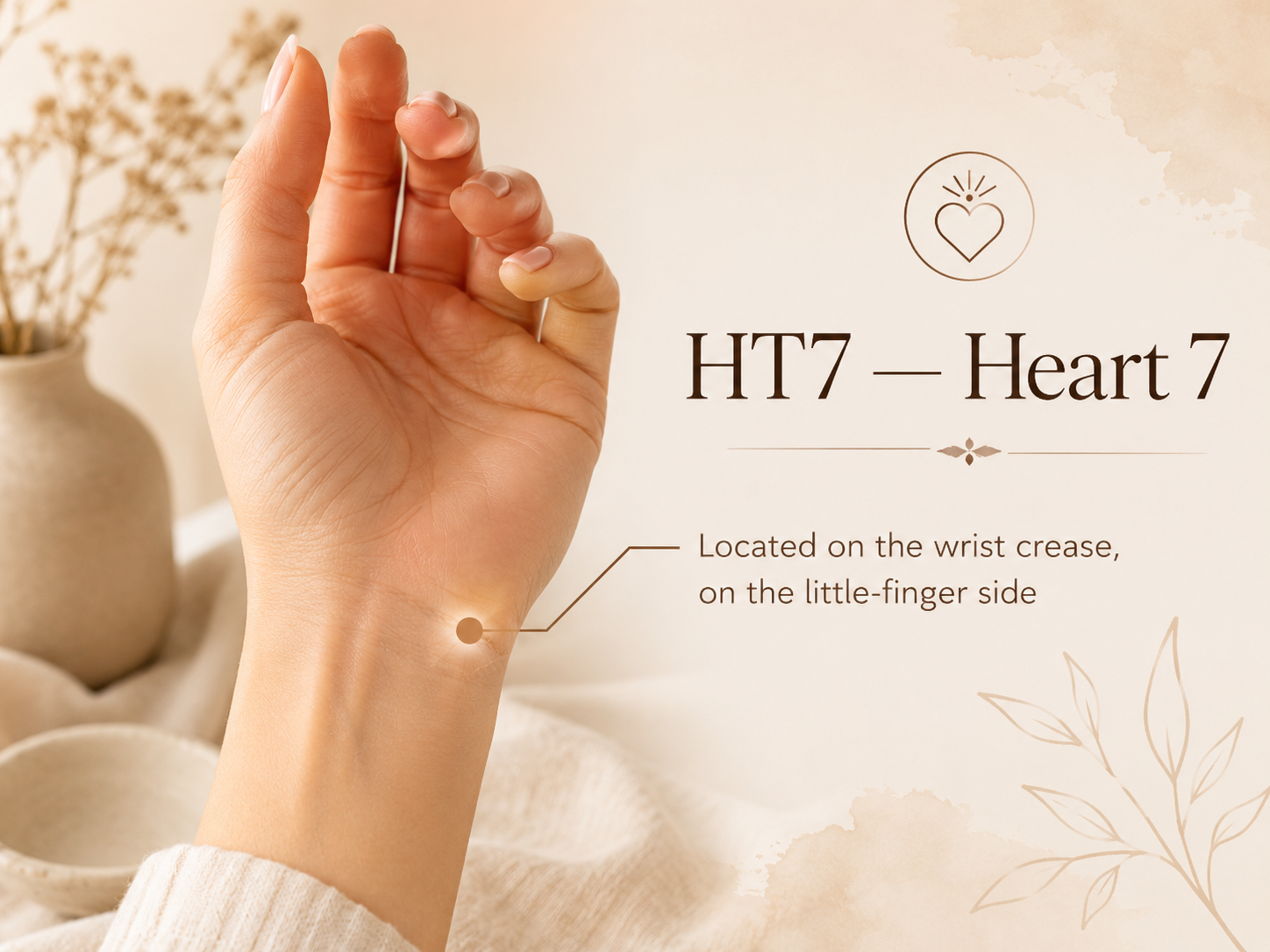
Located at the wrist crease on the little-finger side of the wrist.
Traditionally used when the mind feels restless, the heart feels unsettled, or sleep is difficult.
Try gentle, steady pressure for around one minute while allowing your exhale to lengthen naturally.
🌿 KI3 — Kidney 3
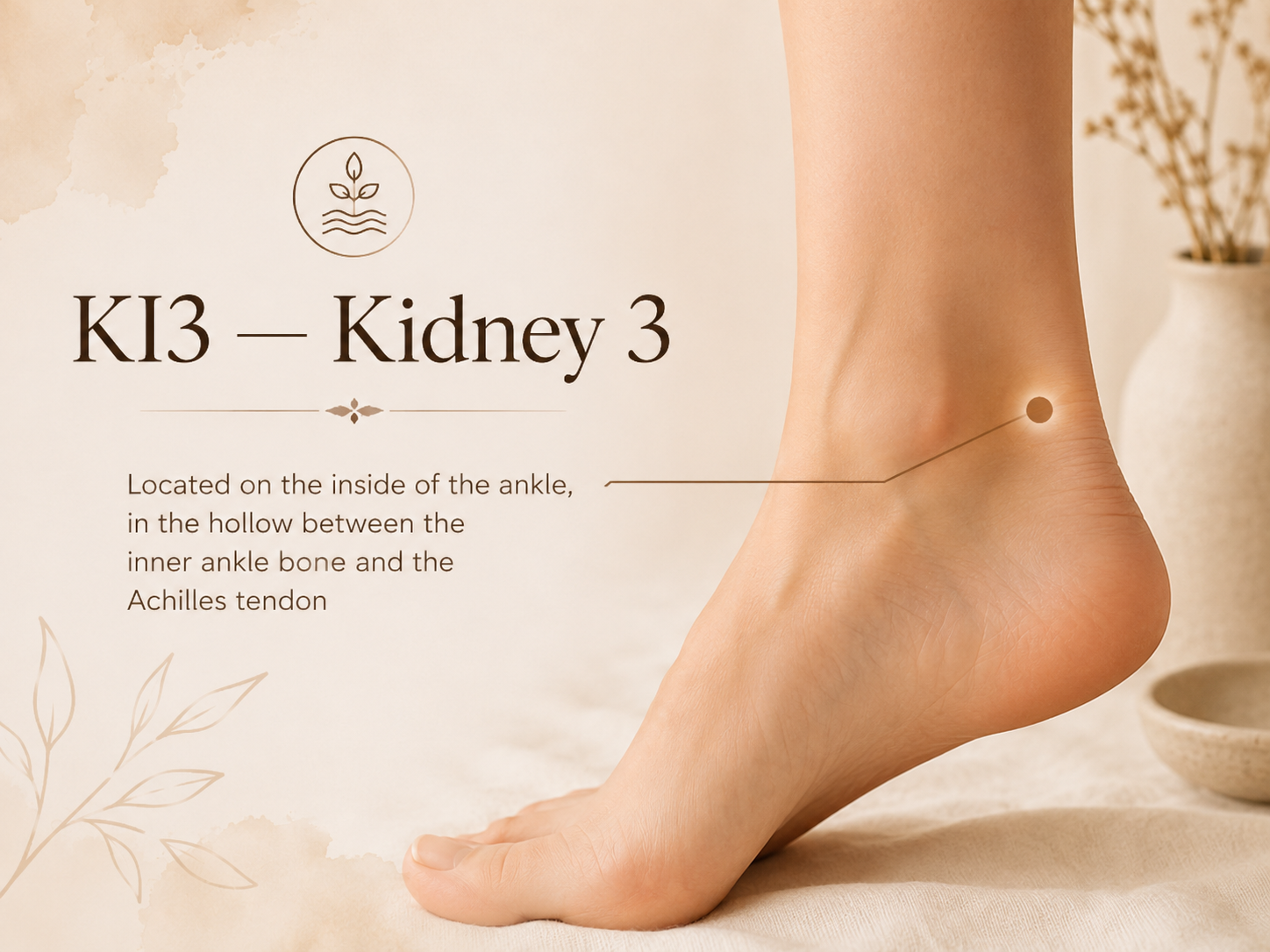
Located on the inside of the ankle, in the soft hollow between the inner ankle bone and the Achilles tendon.
This is a commonly used traditional point in menopause-focused acupuncture patterns.
From a TCM perspective, it is often chosen when hot flashes coexist with depletion, poor sleep, or night sweating.
🌙 SP6 — Spleen 6
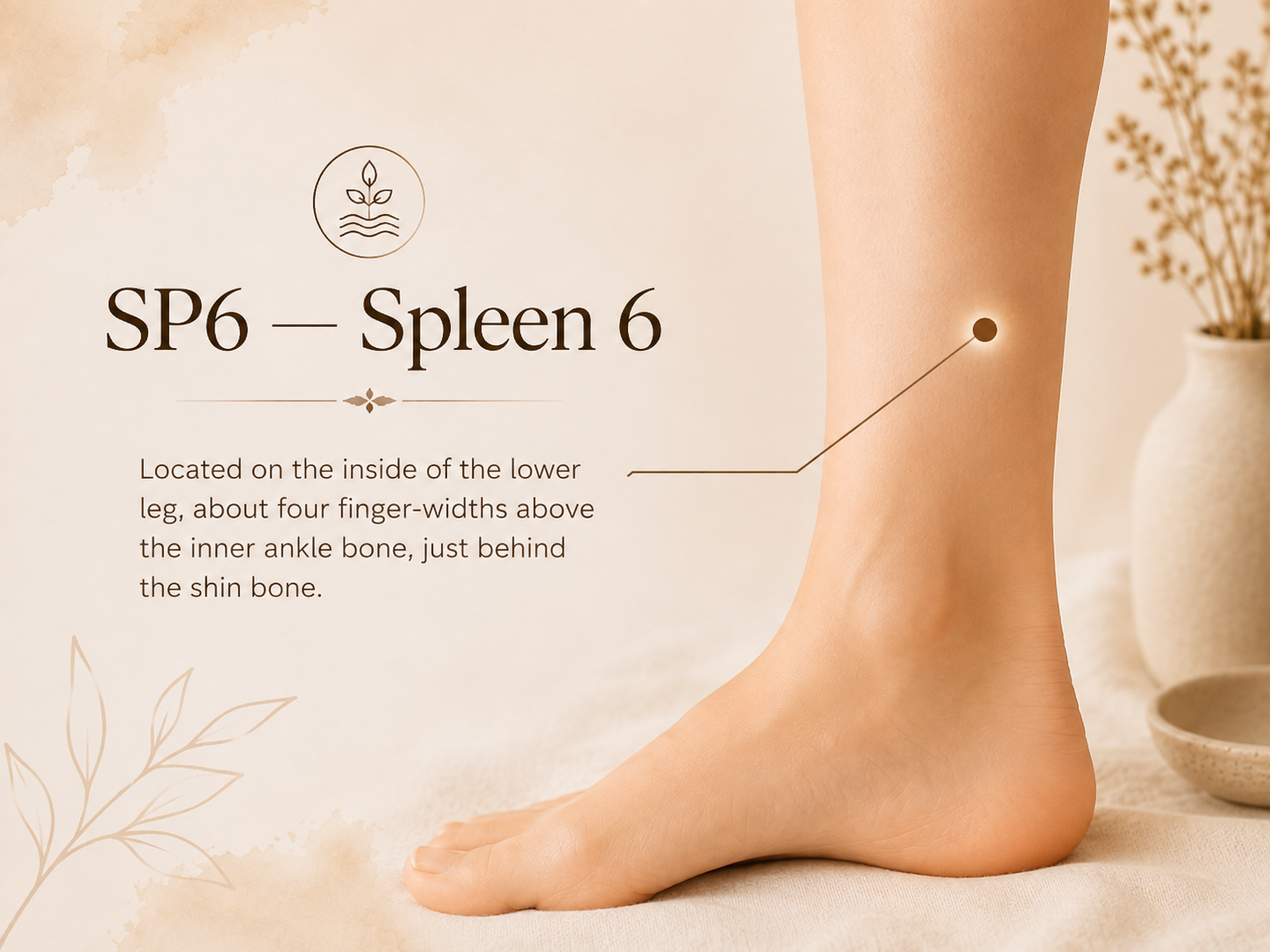
Located roughly four finger-widths above the inner ankle bone, just behind the edge of the shin bone.
This point is commonly included in acupuncture approaches for menopausal symptoms and is traditionally associated with several systems involved in female reproductive health, sleep, and regulation.
Because SP6 is traditionally avoided during pregnancy, women who could be pregnant should not use this point without professional guidance.
You do not need twenty pressure points.
Three points learned well and used consistently can be far more useful than an overwhelming chart of places to press.
And if symptoms are frequent or strong, this is where working with a qualified acupuncturist can take things much further.
A practitioner can select points according to whether your pattern looks primarily like:
🔥 excess heat
🌬️ nervous-system instability
🌙 depletion with night sweating
💓 anxiety and palpitations
😴 sleep disturbance
🌿 digestive or constitutional imbalance
That personalization is where acupuncture becomes particularly valuable.
🌿 Ayurveda Offers Another Layer of Support
Ayurveda would not automatically treat every woman with hot flashes in exactly the same way.
And this matters.
One woman may be naturally warm, intense, driven, and prone to overheating.
Another may experience hot flashes while simultaneously feeling depleted, anxious, dry, and cold between episodes.
Another may have heavier digestion, slower metabolism, and a very different symptom picture again.
The symptom may be called “hot flash” in all three women.
But the body producing it is not the same.
This is why understanding your natural constitution matters.
🌸 What About Natural Supplements?
Shatavari is one of the best-known Ayurvedic herbs traditionally used to support women through hormonal transitions.
It is often described in Ayurveda as nourishing and cooling, making it particularly interesting when perimenopause includes combinations such as:
🔥 heat or flushing
🌙 disturbed sleep
🌿 depletion
😣 irritability
💧 dryness
🪫 feeling as though your reserves are running low
🔥 But Why Are YOUR Hot Flashes Happening?
This is the question that changes everything.
Two women can both wake at 2:30 a.m. sweating.
But one had an extremely stressful day.
Another drank wine with dinner.
Another went to bed after an intense workout.
Another has been chronically under-eating.
Another is naturally heat-prone.
Another has spent six months emotionally exhausted and pretending everything is fine.
The hot flash is the same label.
The pattern behind it may be completely different.
That is why simply asking:
“What gets rid of hot flashes?”
is often less useful than asking:
“What repeatedly pushes MY system toward a hot flash?”
🧭 Start Looking for Your Pattern
For a week or two, pay attention to the hours before your worst nights.
Did you:
☕ drink more caffeine than usual?
🍷 have alcohol?
🌶️ eat something that reliably makes you feel hot?
🏃 exercise intensely late in the day?
🍽️ skip meals or eat very little?
😣 experience conflict or emotional stress?
💻 work or scroll right up until bedtime?
🥱 begin the evening already completely exhausted?
📅 notice the episodes clustering at a particular stage of your cycle?
You are not trying to create another obsession.
You are collecting clues.
Your body is giving you data.
🌿 And Sometimes the Investigation Has to Go Deeper
This is the layer I do not think women hear enough about.
You can support the nervous system.
You can learn acupressure.
You can investigate herbs.
You can change your environment.
But perimenopause is also happening during a profound stage of life.
For many women, the nighttime quiet brings up questions that daytime busyness keeps buried.
Questions like:
Am I actually happy?
Why am I carrying so much?
Why am I always the one who keeps everything together?
What am I angry about?
What am I tolerating?
What part of my life no longer fits me?
What do I want the second half of my life to look like?
This does not mean that unresolved emotions “cause” hot flashes.
It means the body, nervous system, emotional life, and hormonal transition do not exist in separate boxes.
Sometimes physical regulation is the first step.
Sometimes emotional work becomes part of the next step.
Sometimes there is a spiritual question underneath everything:
Am I still living in a way that feels true to who I am becoming?
Perimenopause has a way of making that question much harder to ignore.
🌿 Learning How to Calm the Nervous System
One of the most useful skills you can develop is knowing what to do when your body suddenly moves into high alert.
Because saying:
“I should relax.”
and knowing how to actually help the body settle are two very different things.
This is exactly why I created my FREE PeriPower Nervous System Reset.
It is a short, body-based guide designed to help you begin communicating calm directly to your nervous system—particularly when tension rises, your body feels “on edge,” or you wake activated at night.
👉 Download the FREE PeriPower Nervous System Reset
It is a first step.
Not the entire solution.
🌿Understanding the Body You're Working With
The next question is:
Why does MY body react this way?
This is where Ayurveda becomes powerful.
Your natural constitution influences how you respond to:
🔥 heat
🌙 sleep disruption
🍽️ food
🏃 exercise
😣 stress
🌿 herbs
⚡ stimulation
Knowing whether your natural tendencies are more Vata, Pitta, Kapha—or a combination gives you a much more useful starting point than following generic menopause advice.
👉 Take the FREE Dosha Quizto begin understanding your unique body type.
Again, it gives you the map.
But a map and knowing exactly how to navigate the terrain are not quite the same thing.
🌿 The Bigger Gap: Knowing What to Do With All These Signals
Eventually, perimenopause asks for something much more empowering than knowing which tea to drink or which pressure point to press.
It asks you to understand your body well enough to know:
🌿 when you can regulate yourself
🤲 which self-help techniques suit your particular body
🧭 when a recurring symptom is revealing a deeper pattern
🌙 when sleep, stress, nourishment, movement, or emotions need attention
🩺 when self-help is no longer enough
👩⚕️ when a GP, gynecologist, endocrinologist, or another medical specialist is appropriate
🌿 when an Ayurvedic practitioner may help you understand constitution, digestion, lifestyle, and herbs
📍 when a TCM practitioner or acupuncturist may offer more targeted treatment
And ultimately:
✨ how to stop reacting to symptoms one by one and start understanding the woman experiencing them.
That is the deeper work I do inside my 1:1 PeriPowerful Coaching Program.
We do not simply chase individual perimenopause symptoms.
We look at the full picture: Mind, Body and Spirit